

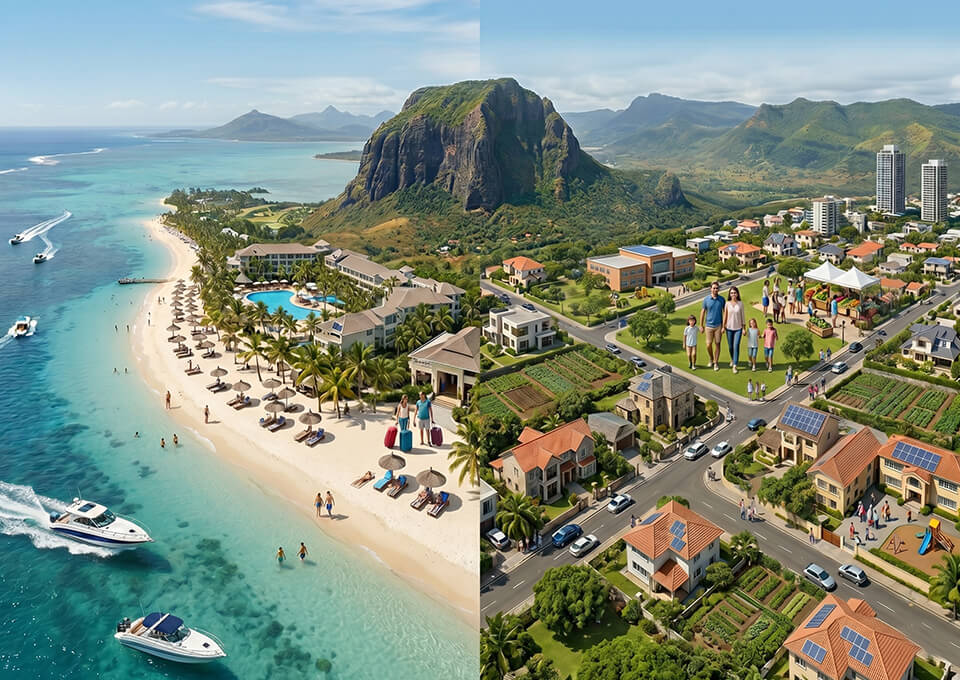
The Mauritius real estate market is not a single, undifferentiated entity that rises and falls uniformly in response to any given economic event. It is a collection of distinct sub-markets, each driven by its own specific demand factors, each with its own cyclical pattern, and each requiring its own analytical framework for the investor who seeks to understand, anticipate, and profitably navigate its movements. Among the most important distinctions in the Mauritius market is the difference between tourism-driven real estate, primarily hospitality assets and the premium IRS and PDS residential properties whose demand is significantly correlated with international tourism flows, and more purely residential real estate, whose demand is driven primarily by domestic buyer needs and by the residency and lifestyle motivations of international buyers rather than by tourism activity.
Understanding how these two distinct cycles operate, how they relate to each other and to the broader Mauritius economy, and what their different patterns mean for portfolio strategy is essential for any investor seeking to build a resilient and intelligently structured Mauritius real estate portfolio. The Apavou Group, with more than four decades of continuous market engagement across multiple Mauritius property categories, including commercial assets like Plaisance Mall, mixed-use developments like The Cube, and residential developments like Terre d’Été, has observed and navigated both cycles through their respective phases, developing an institutional understanding of their dynamics that informs the group’s current portfolio composition and strategic direction.
The tourism-driven cycle, characteristics and drivers
Tourism-driven real estate in Mauritius encompasses the hospitality sector, hotels, resorts, villas, and serviced apartments, and the premium IRS and PDS residential segment, whose demand is significantly driven by international buyers who first encounter Mauritius through tourism and whose investment and residency decisions are influenced by the quality and character of the island’s tourism offering. These two categories are linked by their shared dependence on international visitor flows and by the correlation between the health of Mauritius’ tourism economy and the willingness and capacity of international buyers to acquire and hold Mauritian real estate.
The tourism-driven Mauritius real estate cycle is therefore heavily influenced by global factors that are largely external to the island’s own control: the economic conditions in major source markets including Europe, South Africa, and increasingly Asia; the competitive positioning of Mauritius as a destination relative to alternative Indian Ocean and tropical destinations; the air connectivity available to the island, which directly affects accessibility from key source markets; and the occurrence of global events, health crises, geopolitical disruptions, financial market dislocations, that can rapidly and severely curtail international travel demand. The sensitivity of this cycle to these external factors was demonstrated with particular force during the Covid-19 pandemic, when the near-complete cessation of international tourism created an economic shock of exceptional severity for the tourism-linked segments of the Mauritius real estate market.
The speed and amplitude of the tourism-driven cycle
One of the defining characteristics of the tourism-driven real estate cycle in Mauritius is its capacity for rapid and severe movement in both directions relative to the underlying economic fundamentals of the island. International buyer demand for premium Mauritius residential properties can increase rapidly when positive sentiment momentum builds, when strong word-of-mouth from existing owners, positive international media coverage, and favourable exchange rate movements combine to create a wave of inbound buyer interest. Equally, this demand can contract rapidly when adverse global conditions, financial market disruption, travel disruptions, or negative sentiment events reduce the flow of international capital seeking investment in destinations like Mauritius.
This speed and amplitude of the tourism-driven cycle create both risk and opportunity. For investors who are well-positioned, well-capitalised, and holding quality assets at the moment of maximum negative sentiment, as the Apavou Group was positioned at various cyclical low points in the Mauritius market, the corrections create genuine acquisition opportunities at prices that reflect temporary demand contraction rather than fundamental deterioration in asset quality or long-term value. For investors who are over-leveraged, holding below-quality assets, or facing funding pressure at the wrong moment in the cycle, the same corrections can be catastrophic.
Post-Covid recovery, what the tourism cycle tells us
The trajectory of the Mauritius tourism-linked real estate market following the severe Covid-19 disruption provides an instructive recent case study in the cycle’s characteristics. The disruption of 2020-2021 was severe and rapid; international arrivals essentially ceased for an extended period, creating unprecedented pressure on hospitality operations and significantly reducing international buyer activity in the premium residential segment. The recovery, when it came, was also relatively rapid and stronger than many observers had anticipated, driven by pent-up demand from international buyers and visitors, by the continued attractiveness of Mauritius as a destination for lifestyle investment and residency, and by the competitive differentiation of the island within the Indian Ocean luxury tourism market. This recovery pattern, rapid correction followed by strong recovery for quality assets in quality locations, is consistent with the historical pattern of the Mauritius tourism-driven cycle and reinforces the value of holding quality assets through cycle downturns rather than selling at the point of maximum adverse sentiment.
The residential cycle, different drivers, different patterns
The residential real estate cycle in Mauritius, particularly the domestic market serving Mauritius residents and the mid-market international buyer segment motivated by residency and lifestyle rather than tourism, operates with meaningfully different drivers and different cyclical characteristics than the tourism-driven segment. Domestic residential demand in Mauritius is driven primarily by household income growth, by the formation of new households within the island’s population, by mortgage market conditions including interest rates and lending criteria, and by the government’s housing policy including the availability and terms of social housing programmes.
This domestic residential demand is substantially less sensitive to the global economic factors that drive the tourism-linked premium segment, it does not disappear when international tourism collapses, it is not driven by exchange rate movements between the rupee and major global currencies, and it does not depend on the willingness of high-net-worth international buyers to commit capital to a foreign jurisdiction. This makes domestic residential demand a more stable and predictable base of real estate activity than the internationally driven premium segment, it does not offer the dramatic upside potential of premium international demand in peak years, but it also does not contract as sharply in adverse global conditions.
How the cycles interact and overlap in the Mauritius market
The tourism-driven and domestic residential cycles in Mauritius are not completely independent; they interact with each other and with the island’s overall economic performance in ways that are important for portfolio investors to understand. When the Mauritius economy is performing strongly, with robust tourism receipts, growing financial services activity, and rising employment and income levels, both cycles tend to perform well, creating conditions of broad-based real estate market strength where different asset categories all benefit from favourable underlying conditions.
When a sector-specific disruption hits the tourism economy, as Covid-19 illustrated dramatically, the immediate impact falls most heavily on the tourism-linked premium segment, while the domestic residential segment is buffered to a significant degree by its different demand driver base. Over time, if the tourism disruption extends and creates sustained economic contraction across the Mauritian economy, the domestic residential segment will also feel the effects through rising unemployment, reduced income growth, and tighter mortgage credit conditions. But the timing of impact differs, and the amplitude of impact typically differs as well, creating the conditions for the kind of portfolio diversification across both cycle types that the Apavou Group’s Mauritius portfolio, with its spread across Plaisance Mall’s commercial demand base, Terre d’Été’s quality residential positioning, and The Cube’s mixed-use profile, is designed to deliver.
Portfolio implications, how to blend cycle exposures
The practical portfolio implication of the distinct tourism-driven and residential real estate cycles in Mauritius is that the most resilient Mauritius real estate portfolios are those that combine meaningful exposure to both cycle types, capturing the upside potential of the tourism-driven premium segment in favourable international conditions while maintaining the income stability and demand resilience of the residential and commercial segments through periods of tourism sector disruption.
This blended exposure approach, which characterises the Apavou Group’s portfolio composition, with assets spread across tourism-influenced and domestically driven demand categories, is not about perfectly optimising for maximum returns in any single market scenario. It is about constructing a portfolio that can perform acceptably across the full range of market scenarios that the Mauritian economy will inevitably produce over any extended holding period, rather than a portfolio that performs brilliantly in the most favourable scenario but is devastated by the less favourable ones.
Monitoring cycle indicators for Mauritius portfolio management
Active portfolio management in the Mauritius real estate context requires systematic monitoring of the leading indicators for both the tourism-driven and residential cycles, so that portfolio positioning adjustments can be made in anticipation of cycle turning points rather than reactively after they have already occurred. For the tourism-driven cycle, the most relevant leading indicators include international tourist arrival numbers and growth trends, booking data for the island’s hotel sector, international air capacity and load factor trends on key Mauritius routes, exchange rate movements affecting the cost of Mauritius travel for key source market visitors, and global economic sentiment indicators in the major source markets.
For the domestic residential cycle, the leading indicators include Mauritius domestic income and employment trends, the availability and terms of mortgage finance from local banking institutions, government housing policy developments, and new household formation trends within the island’s demographic trajectory. Monitoring both sets of indicators simultaneously, and understanding their implications for different segments of the Mauritius portfolio, is the analytical discipline that enables sophisticated portfolio management across the market’s distinct cycle types.
Understanding both cycles to manage all conditions
The distinction between tourism-driven and residential real estate cycles in Mauritius is not an academic classification; it is a practically important analytical framework that informs portfolio construction, asset selection, timing of acquisitions and disposals, and leverage management across the full range of conditions that the Mauritius real estate market produces over time. Investors and developers who understand both cycles, their drivers, their patterns, their interaction effects, and their portfolio implications, are equipped to build and manage Mauritius property portfolios that genuinely perform across multiple market environments. This understanding, built and refined through four decades of direct market engagement by the Apavou Group, is one of the most important analytical foundations of the group’s sustained performance in the Mauritius real estate market.
 Previous Post
 Next Post