

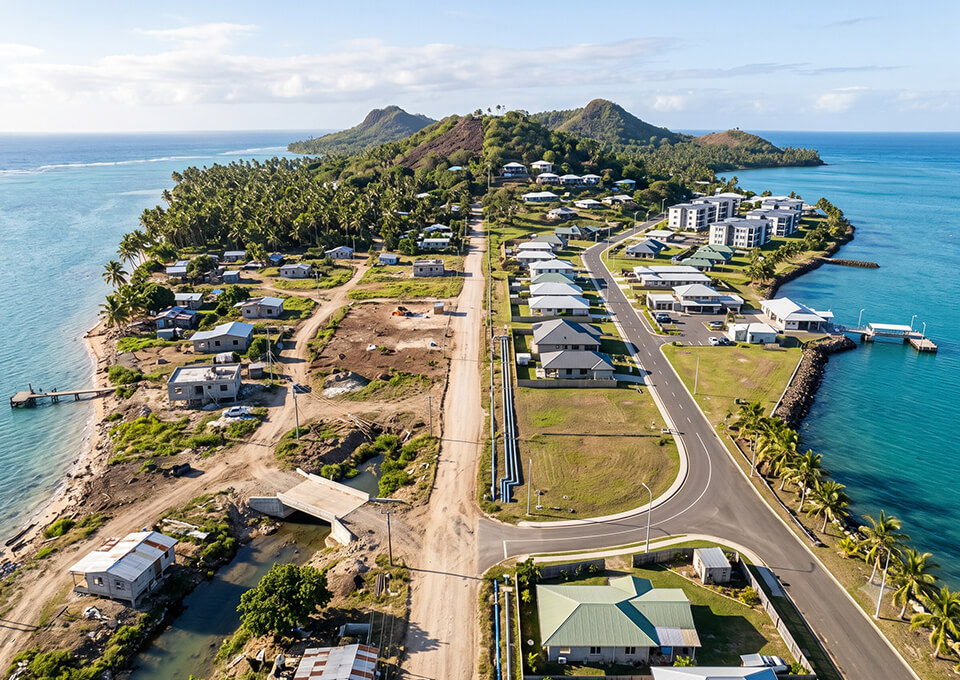
In continental real estate markets, the infrastructure supporting any given development site is usually taken as a given; roads, utilities, telecommunications, and public services are assumed to be available to the standard expected by a particular market segment, and development feasibility analysis focuses primarily on the regulatory and financial dimensions of the development opportunity. In island real estate markets like Mauritius, this assumption of infrastructure availability cannot be made with the same confidence. Infrastructure quality and coverage across the island varies significantly, and the presence or absence of adequate infrastructure is one of the most powerful determinants of whether a specific site can support the development that its physical and locational characteristics might otherwise suggest.
Understanding how infrastructure gaps affect land values, and how infrastructure investment changes those values, is among the most important analytical capabilities for investors, developers, and property owners operating in the Mauritius market. The Apavou Group, with more than four decades of continuous development activity across the island under the leadership of founder Armand Apavou, and with a portfolio that spans Plaisance Mall in the infrastructure-supported airport corridor, Terre d’Été in quality residential areas, and The Cube in established commercial zones, has built an intimate understanding of the relationship between infrastructure quality and property value across different parts of Mauritius.
What infrastructure means for island real estate
The infrastructure that supports real estate development and occupation in Mauritius encompasses several critical categories, each affecting land values through different mechanisms and to different degrees. Road and transport infrastructure, the quality of road surfaces, the capacity of road networks, and the accessibility of specific locations to key economic centres and the international airport, is the most immediately visible and most directly impactful on property values. Locations with excellent road connectivity to Port Louis, Ebene, and the airport consistently command value premiums that reflect the time savings and logistical benefits that connectivity provides to residents and businesses.
Utility infrastructure, the availability of reliable electricity, water supply of adequate quality and pressure, sewage treatment capacity, and telecommunications connectivity, is the second critical infrastructure category. In Mauritius, utility coverage is generally good across the densely settled central and coastal areas of the island, but there are meaningful variations in quality and reliability in more remote or less developed areas that directly constrain the development potential of affected sites. A site that lacks adequate sewage treatment capacity, for example, cannot support residential development above a certain density without significant infrastructure investment, an investment that may or may not be commercially viable depending on the scale of the development opportunity.
The infrastructure premium in Mauritius land values
The infrastructure premium, the value differential between land with full access to quality infrastructure and land with limited or no infrastructure access, is one of the most consistent and most practically significant valuation differentials in the Mauritius land market. Quality serviced land in established residential areas or commercial zones commands prices per square metre that can be multiple times the equivalent price of unserviced land in the same general area, reflecting the substantial cost and time investment required to bring unserviced land to the standard that development requires, and the residual uncertainty that attaches to infrastructure development plans.
For investors assessing land or development opportunities in Mauritius, understanding this infrastructure premium dynamic and accurately assessing the infrastructure status of specific sites, is a critical component of due diligence. A site that appears cheap relative to comparables may be cheap precisely because its infrastructure constraints make it significantly more expensive to develop than a fully serviced alternative. The apparent price advantage can easily be more than offset by the infrastructure investment required to make the site viable.
How Plaisance Mall benefits from airport corridor infrastructure
The Plaisance Mall development by the Apavou Group in Mauritius illustrates the relationship between infrastructure quality and commercial property value particularly clearly. The airport corridor where Plaisance Mall is located benefits from infrastructure investment driven by the airport itself, road improvements to handle airport traffic volumes, telecommunications infrastructure supporting airport operations, and utility services maintained to standards appropriate for a major international airport. This airport-driven infrastructure quality provides an elevated baseline of infrastructure support for commercial development in the corridor that directly supports the commercial property values and tenant demand that make assets like Plaisance Mall viable and successful.
How infrastructure investment transforms land values
The most dramatic land value changes in Mauritius occur when significant new infrastructure investment transforms the development potential of an area. Road improvements that open previously inaccessible coastal or inland areas to practical development can increase land values in affected areas by multiples within a relatively short period, transforming what were marginal agricultural or rural sites into viable development land for residential or tourism uses. Utility infrastructure extensions that bring sewage treatment capacity to previously unserviced development corridors can similarly unlock substantial land value, by enabling the higher-density development that previously could not be practically achieved.
For investors seeking to identify undervalued land opportunities in Mauritius, tracking planned and committed infrastructure investment by the government and utility providers is one of the most reliable leading indicators of future land value improvement. Areas earmarked for significant road network improvement, utility extension, or public amenity development that are not yet fully valued for that planned improvement represent potential acquisition opportunities whose attractiveness depends on the credibility and timeline of the infrastructure commitment.
The risk of infrastructure dependency in development planning
While planned infrastructure investment can dramatically improve land values and development feasibility, dependency on infrastructure that has not yet been delivered carries significant programme and financial risk for developers who incorporate it into their development plans before it is actually available. Government infrastructure programmes in Mauritius, as in most jurisdictions, can experience delays, scope changes, or cancellation, any of which can leave a development that was planned around the availability of specific new infrastructure in a fundamentally more difficult position than the original planning assumed.
Managing this infrastructure dependency risk requires careful due diligence on the status and credibility of any planned infrastructure that a development is relying on, explicit programme contingency for infrastructure delivery delays, and where possible, development of infrastructure solutions that do not depend on government provision, including private utility connections, on-site water treatment, and other self-sufficient infrastructure solutions that give the developer control over the infrastructure availability timeline.
Smart city developments as infrastructure creation
The Smart City developments currently being advanced in Mauritius represent a significant category of private infrastructure creation, integrated developments where the developer provides the full range of infrastructure required for a self-sufficient urban community, rather than depending on pre-existing government infrastructure. These developments, which combine residential, commercial, and leisure uses with comprehensive utilities, roads, and public amenity provision, effectively create their own infrastructure value, transforming greenfield or previously underdeveloped sites into fully serviced development environments through developer-funded infrastructure investment.
The land value implications of this private infrastructure creation are significant: sites that had modest value as unserviced agricultural land or underdeveloped areas can generate substantial development value once the Smart City infrastructure is in place. For investors and buyers in these developments, understanding the infrastructure investment that has been made, and its quality and completeness relative to the development’s long-term needs, is as important as understanding the specific units or sites being acquired.
Practical implications for Mauritius property investment
The practical implications of infrastructure analysis for real estate investment decisions in Mauritius are several and important. For land acquisition decisions, infrastructure status must be assessed as a fundamental feasibility input, not just a background characteristic, with explicit assessment of what infrastructure is available, what is planned and committed, and what would need to be provided or funded by the developer to make the site viable for its intended development use.
For the acquisition of completed investment properties, commercial assets like Plaisance Mall and The Cube, or residential developments like Terre d’Été, the infrastructure quality of the surrounding area is an important determinant of the long-term demand and value trajectory of the asset. Assets in areas with high-quality, well-maintained infrastructure consistently sustain higher occupancy, higher rental rates, and stronger capital value growth than comparable assets in areas with infrastructure constraints or deterioration.
Infrastructure as investment due diligence
In the Mauritius real estate market, infrastructure analysis is not a detail of property due diligence; it is a fundamental input to investment decision-making that shapes the viability, cost, and long-term performance of every significant property investment. Investors and developers who understand the infrastructure dynamics of the Mauritius market, who can accurately assess infrastructure quality and coverage, identify planned infrastructure improvements before they are fully priced into land values, and manage infrastructure dependency risk in their development programmes, consistently make better investment decisions and achieve better long-term portfolio performance. This is one of the areas where the Apavou Group’s four decades of direct Mauritius market engagement provides among the most valuable and most directly applicable institutional knowledge.
 Previous Post
 Next Post